My Life With My Back: a story of back pain recovery.
I suffered from chronic low back pain for over fifteen years. At a young age, I did one hundred full sit-ups (abdominal exercises) daily. Later I was to learn that this caused my psoas muscle to become tight and distorted – beginning the onset of pain in my low back region. I reported low back pain to physicians as a teenager (they did nothing). As an adult, my low back pain would occur daily after four to five hours of normal activity. By late afternoon, I had to lie down for the rest of the day to ease the pain. My back pain was so severe that I considered becoming addicted to opiate painkillers like oxycontin. This is my story of my trials, frustrations, experiments, and succeses with chronic low back pain.
I went to over forty specialists looking for help. These practitioners included: Neurosurgeons, Internists, Orthopedic surgeons, Physical therapists, Psychologists, Chiropractors, Acupuncturists, Rolfers, and Massage therapists.
The methods I tried included:
Yoga (five years of practice including Hatha, Iyengar, Kundalini, and Astanga);
Thai massage in Thailand.
Doctor prescribed medications;
Dr. John Sarno’s method;
Rolfing and Structural Integration;
Gary Glum’s Neuromuscular reeducation;
Thomas Griner’s cross fiber friction technique
Richard Rossiter’s method
John Barnes’ Myofascial Release
Pilates and Gyrotonic
DRX-9000 machine and Inversion (anti-gravity) machine
Michael Leahy’s Active Release Technique
Alexander Technique
Proprioceptive Neuromuscular Facilitation (PNF stretching)
Shiatsu
Russian Massage
Raw food and vegetarian diets
Swimming and walking
My diagnosis was called different names by different specialists: degenerative disc, flat back syndrome, anteriorly tilted pelvis, sacro-iliac pain, and non-specific back pain (which means the doctor doesn’t know). Irregardless of the name being ascribed to the condition, none of these specialists could do anything about it. I was seeing one specialist after the other. I wasn’t getting any better and I was seeing a lot of overlap between different styles. Enough was enough. Either I get an operation. Or I become addicted to painkillers. I did neither. I enrolled in massage school and later attended instructor training courses in Pilates and Gyrotonic. I needed more information to better discern my path for recovery. I was extremely frustrated by the ineffectiveness of the numerous treatment programs I had tried. From these experiences, I decided not to become a practitioner of any method unless it significantly helped me to resolve my own pain.
After doing 300 hours of training at the local massage school in Southern California, I attended a four-day workshop with Aaron Mattes and his method: Active Isolated Stretching and Strengthening. Feeling that the Mattes Method offered potential, I interned at Aaron Mattes’ clinic in Sarasota, Florida. After my first treatment session, something productive was finally happening.
I had been experimenting with different stretching systems for over ten years. Yoga, Thai massage, Russian massage, PNF stretching, Pilates, Gyrotonic, Active Release Technique, Alexander technique, Rossiter method, and Rolfing all used some stretching to facilitate recovery, but Aaron Mattes’ Active Isolated Stretching put a new approach on how to stretch. I received some benefit from the other methods, but the benefit was short lived – usually lasting a day or two. Aaron Mattes, trained as a kinesiologist, explained why the common methods of stretching were not optimal. He identified seven mistakes in common stretching and proposed a new route to cure musculoskeletal pain.
Before my first treatment in Active Isolated Stretching, two hours of standing was enough to trigger pain in my low back. After that first session, I was able to stand and move around for eights hours! I continued with more treatment sessions with Aaron Mattes and after the third session I was returning to a normal schedule of work and social activity. I no longer have to stop all activity at 5PM to lie down. I attribute my recovery entirely to the Mattes Method. Since that first internship, I’ve compiled 1000 hours of direct study with Aaron Mattes. He refers to me as one of his top five practitioners in the world.
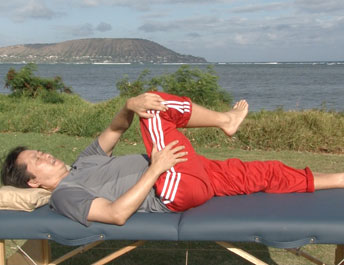
Active Isolated Stretching is good for everyone. Athletes will improve their performance, people with physical pain will resolve their ailments, elderly will improve the functioning of their bodies and minds, and those with neuromuscular disorders will greatly benefit, including complications from stroke, Parkinson’s, Alzheimer’s, fibromyalgia, spinal cord injuries, and scoliosis.


My husband is suffering from sciatica pain. He had surgery a few years back for sciatica pain because of a compressed disc. It cured the nerve pain but never relieved the lower back pain. He pulled something in his back a week ago on the other side from his surgery then suddenly his sciatic nerve is irritated and causing pain. Is this something you are able to relieve? I’m also interested in learning your stretching techniques. Please contact me as soon as possible.
Hi Erin R.,
Unfortunately, your husband’s story is very common. The cases where back surgery is not successful is so common that there is a name for it; it’s called “failed back surgery.”
The important thing to realize is low back pain is a muscular problem. When the muscles affecting the low back are excessively tight, problems like sciatic nerve pain or pain in the low back can be present because the muscles of the body are compressed. My paid videos show people how to do the self-stretching exercises. If you live in Honolulu, we can also arrange for private treatment sessions which will be very helpful for resolving the pain.
Sent by,
Anthony Ohm
I have a fused S1, L5 and a bulging disc at L5, L4 (left side). I have tried a number of different therapies – physio, massage, acupuncture, water aerobics, and enzymes. I feel the problem is getting worse because the pain has progressed from my calves to my buttocks. I am interested in purchasing your instructional videos. How do I go about this? Thanks very much
Hi Diana S.
I will notify you when the instructional videos are ready. They will be available for purchase and viewing straight from my website. That’s part of the reason its taking so long to get them ready, I’m using a newer technology similar to live streaming video content.
In 7/2711 I had 2 artifical disks installed in my back. L3-4 & L4-5. In 5/21/12 I had my rt hip replaced for the 2nd time. I wore the first one out. My rotator muscles are very tight causing me much pain, including some sciatic pain. I am currently going through physical therapy, but it is not helping very much. I cannot sit for any amount of time without errata ting the muscles. I have to lay on my back and take pain killers to releave the pain. Can you get rid of the pain? And if so how many treatments will it take? I live I orange county cal.
Mr. Ohm, I just came upon your website from the youtube selection on shoulder stretches. I read your story. I was intrigued because I had a patient, 50+ tennis player with unilateral hypertonic psoas muscle due to a trauma to the L1,2,3 as a youth. The MRI showed calcifictions in these leveIs. The patient was taking anti-TB medication, as prescribed. The MD decided that the whitish scar calcification on the spine was a tubercle bacterial invasion in the spine. In your case it was years of repetitive onslaught on the same levels, causing instability and hypedeveloped psoas. The instability on those lumbar levels caused the psoas muscles to compensate by hypertonicity and, woorse, spasm to protect the already unstable lumbars. On my patient, the MRI,besides the discal calcifications, showed dramatically higher density of the psoas M. on one side compared to the other (darker shadow; This is a subtle but very important indicator of muscle inflammation and hypertonicity). This is a muscle that has been ooverworked and finally gave up. I jogged his memory deeper about a fall a long time ago. Like a bulb that lit up, he remembered falling from his bike as a teen and landing on his lowerside. The pain eventually resolved but there was a permanent trauma to the spine that surface 20-25 years later. I Tell this story because the psoas muscle is a mysterious, but powerful muscle. It’s full name is iliopsoas M. 2 combined muscles for hip flexion. Worse yet, this is the muscle often overlooked in cases of LBP.
I would like to ask you how your psoas spasms were diagnosed. What practicioner looked into this pelvic area?
If you are interested I can share a technique to check the psoas.
Sincerely, Dr. Oliva – text: 909-269-9526
Hi Dr. Oliva,
Thank you for your comments. I practice in Honolulu, Hawaii. My location is close to Waikiki. I think that you live in Southern California. I will be returning to your area in July, 2012. Perhaps we can meet then.
Dysfunction in the psoas muscle is not yet well recognized by pain specialists. The overwhelming majority of low back pain cases involve an overly tightened psoas muscle. In my case, I experienced this from an unusally early age (16) because of doing full sit-ups daily and in high repetition. But the psoas muscle also gets tightened from long periods of sitting. And sitting is the primary activity of humans working in the industrialized world. A typical 50 year old has spent thousands of hours in the sitting position – the cumulative effect being a common cause of low back pain. This is a major reason why low back pain is so common throughout the world today.
Additionally, years of playing tennis can contribute to low back pain. All the quick reaction activities, rotational movements, and playing on a hard surface contribute to low back pain issues. The quick stop and go movements of tennis can lead to tightened hip rotator muscles – the deep six. And the sudden sprinting tightens the quadricep and hamstring muscles. Abnormal tension in all these areas also contribute to low back pain cases. Which is not to say that tennis should be avoided. Active Isolated Stretching sessions with a trained therapist can prevent low back pain from developing in the tennis player. As more people learn about AIS, larger numbers will seek out this treatment for a broad range of reasons.
I am not discounting the bicycle fall that your client experienced as an important incident. Long periods of sitting and his sport may also have played a role in causing his spine to deteriorate.
The person who identified my psoas as being a primary cause of my low back pain was Aaron Mattes, the developer of Active Isolated Stretching.
I went to forty different pain specialists before meeting Aaron Mattes. And when I saw how effective his method was I went from patient to practitioner.
Anthony Ohm
Hi Anthony, I feel blessed to have found your website. I am 30 years old and have already had a cervical fusion. i live with chronic neck pain every single hour of every single day. I have done numerous PT with no relief. I am going from one dr to another and getting nowhere. I am desperate for relief and to be able to live my life as a normal 30 year old.
Sincerely
Amber F
Amber,
I am glad that you found my website. I’ve spent hundreds of hours writing these articles for people who are searching for something new; Something that is a major departure from same old same old. The first step to getting out of physical pain, is looking outside the box. You’re on your way.
Best progress,
Anthony Ohm
greetings
my story sounds similar to yours but in my gluteal/hip/high hamstring area. i have seen many specialists treatments, etc with different dx/tx. for over a year i have experienced daily pain -somewhat improved over the last month but still persistent daily. i used to run marathons, 1/2 iron etc. now i am just able to run 8 miles most. i will be in hawaii 2/17 to 25 if you are available or we live in northern california.
please advise. i would like to try this treatment. it makes sense to me.
Hi Andrea H.
Yes, years of long distance running will place a strain on the body. And the answer is simply lengthening the muscles that have become worn out. I will be in Honolulu during the time you mentioned. So, I’ll be available to see you.
Best regards,
Anthony Ohm