Hip pain is caused by excessive muscular tension in the lower body which pulls the pelvis (hip bone) out of alignment, which causes pain. Additionally, tightened hip rotator muscles restrict range of motion in the hip socket, which wears down the cartilage inside the hip socket. Hip pain is a musculo-skeletal problem.
Hip pain causes
Hip pain involves a series of muscles. All the muscles that attach to or surround the pelvis need to be treated to unwind hip pain. Muscles that need to be addressed are the calves, hamstrings, groin (adductors), ilio-tibial band (I.T. band), psoas, glutes, quadriceps, and the hip rotator muscles of the thigh-hip junction. The best approach to resolve hip pain is to receive assisted stretch therapy in a method called Active Isolated Stretching (AIS). AIS first unwinds the larger muscles of the lower body. Afterwards, AIS loosens the hip rotator muscles, also known as the deep six muscles. The deep six muscles are the small muscles of the hip that create rotation and control pressure inside the hip joint. Conventional Stretching techniques are inadequate in preventing or repairing hip pain because the procedure does not completely open the targeted muscles.
How do the hip rotators become painful?
Hip pain is created by tightness in large outer muscles of the lower body and tightness in small inner muscles of the hip – the hip rotator muscles. Just addressing the hip rotator muscles will not cure hip pain because the more external (superficial) muscles form a cast over the hip rotators that must be stretched first.
The glutes. A tight buttocks contributes to hip pain
The glutes are directly external (superficial) to the hip muscles and they are a prime example of large external muscles forming a restrictive cast around the hip rotators. In AIS therapy, the client lays on a table and is held down with a seat belt to isolate the gluteal muscles. Glute stretches (there are five in AIS therapy) will be more productive with a trained therapist assisting because people with hip pain usually have major restrictions in the glutes.
Tightness in the hip is caused by a collection of restricted lower body muscles
Hamstrings, quadriceps, and groin muscles get tight through the aging process, sitting, and through sports and physical activity. The hamstrings, quadriceps, and groin muscles attach at the knee (patella) and the hip (pelvis). So when these muscles are tight they cause a tensional strain on the hip, which contributes to hip pain. The calves are often overlooked in hip pain, but they are among the strongest muscles of the body. Unreleased pressure in the calves pulls the hip bone out of balance in a similar tensional line with the hamstrings. The psoas muscle lies deep inside the stomach. The psoas gets tight through sitting and doing abdominal exercises incorrectly. A tightened psoas creates tension in the junction between the upper thigh and the hip. Therefore, psoas tension must always be examined in hip pain cases.
The I.T. band. Iliotibial band tightness contributes to hip pain
The other major outer muscle affecting the hip is the ilio-tibial band (I.T. band). The I.T. band runs down the leg, lateral to the quadricep. I.T. bands can get tight through aging, sitting, or running and they are very difficult to stretch with self-applied stretching (assisted stretching is necessary). Every person with hip pain has tight I.T. bands. Every runner has I.T. band tightness. Because this muscle attaches at the pelvis (the hip bone). It is a primary contributor to hip pain.
The deep six muscles: final destination.
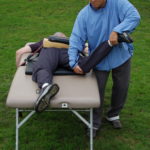
After all these superficial leg muscles are optimally lengthened, then AIS treatment can take place at the hip rotator muscles. Just stretching the above mentioned superficial leg muscles will greatly alleviate hip pain, but the final step involves the deep six muscles (hip rotators). The deep six muscles are the: piriformis, obturator internus, obturator externus, quadratus femoris, gemellus superior, and gemellus inferior. The deep six muscles are small muscles that connect the top the thigh bone to the inside of the hip socket. The hip is a ball and socket joint. Hip rotation is controlled by these small muscles. And if these muscles are not stretched (when someone experiences hip pain) then the range of rotation inside the hip socket will decrease and the pressure inside the hip socket will increase. Limited range of motion and increased pressure inside the hip will wear down the cartilage inside the hip socket. Because tight hip rotators muscles cause a constant friction going over a limited space, which will burrow a hole in the cartilage to the point in which a physician will look at an MRI report and conclude that the client needs hip replacement surgery.
Why would AIS help my hip pain, when conventional stretching didn’t help?
Hip pain can be resolved with Active Isolated Stretching therapy. But it cannot be corrected with conventional stretching, pnf stretching, yoga, or thai massage. The non-AIS forms of stretching hold the stretch for too long. Holding the stretch for more than two seconds elicits the automatic stretch reflex which prevents the target muscle from stretching. The non-AIS forms of stretching ignore stretching at angles, and focus primarily on stretching the belly of the muscle. The belly of the muscle is only one aspect of the target muscle. There are five other areas to stretch in the target muscle which is why muscles that are stretched in conventional stretching don’t retain their flexibility. Additionally, non-AIS forms of stretching use the wrong positions to stretch the target muscle. The target muscle must be relaxed. For example, traditional stretches for the calves and hamstring muscles place the muscle in a state of contraction (specifically called eccentric contraction) and thereby do not allow full expansion of the target muscle.
Internal and external hip rotator stretches
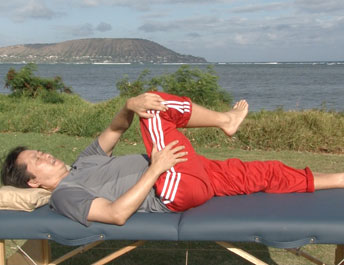
Aaron Mattes, the developer of Active Isolated Stretching, states that his greatest contribution to the field of bodywork may be the internal and external hip rotator stretches that he designed. The deep six muscles are underneath the glutes, psoas, hamstrings, quadriceps, groin, and I.T. band. Opening the hip rotators needs a trained therapist assisting the process. To prove this point, many dancers and yoga practitioners experience hip pain. Both groups do extreme amounts of stretching to the outer leg and lower back muscles, but they commonly experience hip pain. This is because they can’t get reach the deep six muscles on their own. The internal and external hip rotator stretches of AIS takes the pressure off the hip joint. This process creates space inside the hip joint. And creates an atmosphere that can allow worn down cartilage to regenerate. Cartilage can regrow inside joints, a healthy diet and Active Isolated Stretching are two elements that can facilitate this process.


This is very helpful information and it answers many questions that I had. I’ve been experiencing hip and groin pain for several months and today, this article opened my eyes.
Very informative! How do I find the right help? PT?
My initial doctor visit over a year ago left me with little hope other than drugs. :/
I have attempted, on my own with the use of a trigger point foam roller, to keep my it bands, quads and hamstrings relaxed. It has definitely paid off. But you’re right, I need those tiny internal muscles addressed.
Hi Judy,
You can fill out this form and I will find someone in your area. Or you can do your own search.
https://www.resolveyourpain.com/practitioner-finder-locate-an-ais-practitioner-in-my-region/
This information is educational. Also, I am unable to climb/walk up stairs with my right foot. Please explain the sharp electric pain that runs down my right leg ocassionaly. The left foot is good, no complains except diabetic neurapthy. Yes, I so water therapy at the Health Club 3x per week.
Hi Annie F,
The sharp electric pain that runs down your right leg is part of your neuropathy.
You have a series of muscles that are tight that are surrounding your hip and low back. These muscles that are in high tension are putting pressure on the nerve pathway because the nerves run alongside or underneath the muscles. The nerve is being impinged near the hip and low back, and the sharp pain can be experienced in a variety of places: in the buttocks, the upper part of the leg, or the lower leg. In your case, the sharp pain is being felt in your foot. Other people will have that pain in their calf.
Causes and treatment for neuropathy and diabetic neuropathy are the same. Do AIS exercises to unwind the elevated muscular tension in the muscles that are surrounding the sciatic nerve. Open up the muscles of the hip rotators. Open up the muscles of the lower body as well as the lower body. Everything will help.
This sounds like my problem. I ballet & belly dance & do vinyasa yoga
Hi Judi C.,
Yes, hip problems are very prevalent among ballet dancers and also among yoga practitioners.
Sent by,
Anthony Ohm
Thank you for your timely response. PFD is pelvic floor dysfunction. I have high tone
in the pelvic floor, and my PT believes that is what is irritating the nerves that are
creating this constant sense of urgency. I’m an Occupational Therapist so I know
something about anatomy/kinesiology. I think getting to those deep muscles of the
hip will be useful. For one (and you probably know this) the obturator internus is the
conduit for the pudendal nerve. One of the functions of the pudendal nerve is to signal
elimination urges to the bladder and bowel. I’m thinking that if these deep sixes are
tight they are impinging on the nerves and creating false signals. The muscles of my
body have been out of whack for a long while, due to a very sedentary lifestyle and
a whole host of postural bad habits. I hope you return to the Los Angeles area soon.
Hi Lisa K.
The creator of Active Isolated Stretching is Aaron Mattes. He has said that his greatest contribution to the field of bodywork could be the assisted stretches that isolate the deep six muscles. These hip rotator stretches come at the end of a long routine so that all the superficial muscles above the deep six are lengthened and relaxed before addressing the Obturator Internus. Because the AIS method of lengthening the deep six muscles is more thorough than other approaches, it has helped people with elimination issues, prostate cancer, and infertility due to a tipped uterus.
I plan to be back in Los Angeles by June 20th.
I have been experiencing urinary urgency and have a hypertonic pelvic floor. I have
been seeing a PT specializing in PFD for 4 months, who (along with internal treatment) has given me a recommended series of stretching/strengthening exercises to improve my condition (hips, hamstrings, piriformis, isoas, pelvic mobility exercises, postural
exercises – back extensors, rhomboids) with no progress. I was thinking that perhaps AIS that addressing “the deep six” would be useful to me,to try to restore normal pelvic tone. What do you think? I cannot do the usual interior pelvic floor relaxation exercise (“reverse Kegel”) without a rebound in tightening/pain.
Hi Lisa K.
Active Isolated Stretching technique is highly beneficial for the problem you mention. Elimination issues are commonly corrected with AIS, even when other forms of bodywork have been unsuccessful. I recommend that you try some AIS sessions.
I’m not sure what PFD is? Usually people refer to PNF, which is proprioceptive neuromuscular facilitation. That is a complicated way of referring to old style stretch and hold for thirty seconds.
Hi I am a Yoga Instructor that is recovering nine weeks out from total hip replacement, I had significant cartilage erosion, and my labrum was completely severed off the bone. I am still experiencing the same pain I had before the hip was replaced, my physical therapist said my rotator muscles of the hip just aren’t releasing !! And I’m concerned I was told I had a tear in my gluteus medius yet no Dr I’ve visited has said anything about repairing it. Would your AIS therapy help someone like me at this point and if so where are you located I am NJ and I am so desperate for relief I’ve been suffering with this deep awful burning ache in my outside hip, glutes, thigh and down my leg sometimes into my calf, I would appreciate any information, I am in so much pain and I just would like to resume my life I am 39 yrs old. Thank you for your site this information is very helpful also!
Hi Melissa F.
I’m sorry that you are experiencing such a painful episode. Many people who practice yoga extensively are prone to hip rotator problems. Many of the yoga poses place a constant pressure into the hip socket, this is referred to as eccentric contraction being placed on the hip. Eccentric contraction to the hip rotators can result in inflexibility to the deep six muscles and it can cause a shearing force to be placed on the hip which can deteriorate the cartilage inside the hip socket.
“Bone on bone” is a term that I have heard often, and I don’t believe it to be the death sentence that it sounds like. I’ve known others that were given the same diagnosis only to experience a major recovery from AIS treatment.
Sounds like the physicians are not sure whether you have a muscle tear in the gluteus muscle area. In cases like this, AIS may be helpful now or it might require time to heal the tear first.
You can try to do some sessions with the NYC therapist and see how you feel after the sessions. If the pain increases after a few sessions, then you’ve got to wait until that tear heals. But there’s also a possibility that AIS treatment will be very beneficial for you immediately. You’ve got to test it out.
I’ve had problems with my hips for years and was told that it was the tissue/muscles surrounding the joint. I was never clear on that. This website helped me understand a little more. Thanks.
Dear Terry M.,
Most people with hip pain have inflexibility in numerous areas of the lower body. Not just tightness in the hip rotators. Its very common for people with hip pain to also be tight in the calves, hamstrings, quadriceps, gluteus, and psoas muscles. And let’s not forget the I.T. band.
I would say that 90% of hip pain people have additional restriction in some or all of the areas I just mentioned.
Sent by,
Anthony Ohm
Hi Anthony, I wanted to know if my condition would be helped by having some sessions with you. Brief history: in 7/11 and 9/11 I had surgery in both hips to treat FAI and torn labrums. The left hip could not be repaired as the damage was too extensive. On 9/12 I had a total hip replacement on the left hip. Now my right hip has pain in the trochanter area (which is where my pain in both hips has always been.) It may be bursitis which I have had all along. It prevents me from going on a walk longer than 10 minutes, it is challenging to go from sitting to standing as well as doing steps. I have been active my whole life and was teaching yoga for 25 years up until 3 years ago when the pain prevented me from continuing. I am a 55 y/o female that wants her life back! I was introduced to AIS from Phil Wharton right after my symptoms began about 3.5 years ago. I started doing the stretch program 2 days ago on my own yet wondered if working with a practitioner would help more. I also have upper back and neck issues. :) And had a lumbar fusion surgery L5/S1 in 2002. I live in the Santa Barbara area. What do you think?
Can you recommend a therapist near the San Francisco, Bay Area ? Thanks.
That was very well written and very helpful. I live in NJ – can you recommend any AIS practioners in the Englewood, New Jersey area? Thank you in advance.
this was very helpful
Can you recommend a Dr in the Pasadena that does the AIS therapy? thank you .
I am the closest AIS practitioner to Pasadena, California. I see people in Santa Monica. There are only three AIS experts in the entire state. People come from Palm Desert and Fresno to see me. AIS is very effective for resolving hip pain issues, but there is a scarcity of practitioners.